What is Rucking? Benefits of Walking with Weight & Beginner’s Guide
In simple terms, rucking is walking with weight on your back.
It was born from military training (forced marches), but today it stands as the most underestimated “cheat code” in modern fitness. It sits in the perfect middle ground between walking (too little stimulus for some) and running (too much joint impact for others).
If you are looking for a way to build strength, burn fat, and improve your posture without destroying your knees, you’ve found it. Here is everything you need to know, from the science to the gritty reality of what it actually feels like.

More Than a Military March: Understanding What is Rucking
Rucking isn’t complicated, but don’t mistake simple for easy. It transforms a basic human movement into a compound resistance exercise.
The Perfect Middle Ground Between Walking and Running
Running is high impact; walking is low intensity. Rucking bridges this gap. It elevates your heart rate to a fat-burning zone without the pounding mechanics of running. You get the cardiovascular benefits of a jog with the stability of a walk.
Real Sensations: From the “10-Minute Deception” to Mile 3
Here is what nobody tells you about the experience.
When you first strap on the pack, you will likely fall for “The 10-Minute Deception.” You feel invincible. You might think, “This is too easy, I should have added more weight.” Do not listen to that voice.
By mile 3 (roughly 5km), the reality sets in. Interestingly, it’s rarely your legs that fail first. It’s your traps and core stabilizers. The sensation isn’t the “out of breath” feeling you get from sprinting; it’s a dull, constant muscular fatigue in your upper back as your body fights to stay upright. This is where the real work happens.
Science-Backed Benefits of Rucking
Why are doctors and fitness experts suddenly obsessed with this? Because the physiological return on investment is massive.
1. Zone 2 Cardio: Heart Health Without Spiking Cortisol
Rucking is the king of Zone 2 training. It keeps your heart rate elevated enough to improve cardiovascular health and mitochondrial efficiency, but it doesn’t spike your cortisol (stress hormone) levels the way high-intensity sprinting does. It’s sustainable fitness.
2. Wolff’s Law: Bone Density and Osteoporosis Prevention
Wolff’s Law states that bones adapt and strengthen under load. Rucking applies a compressive load to your spine and hips, signaling your body to build denser bone tissue. It is one of the best preventative measures against osteoporosis.
3. Postural Correction and the “Office Hump”
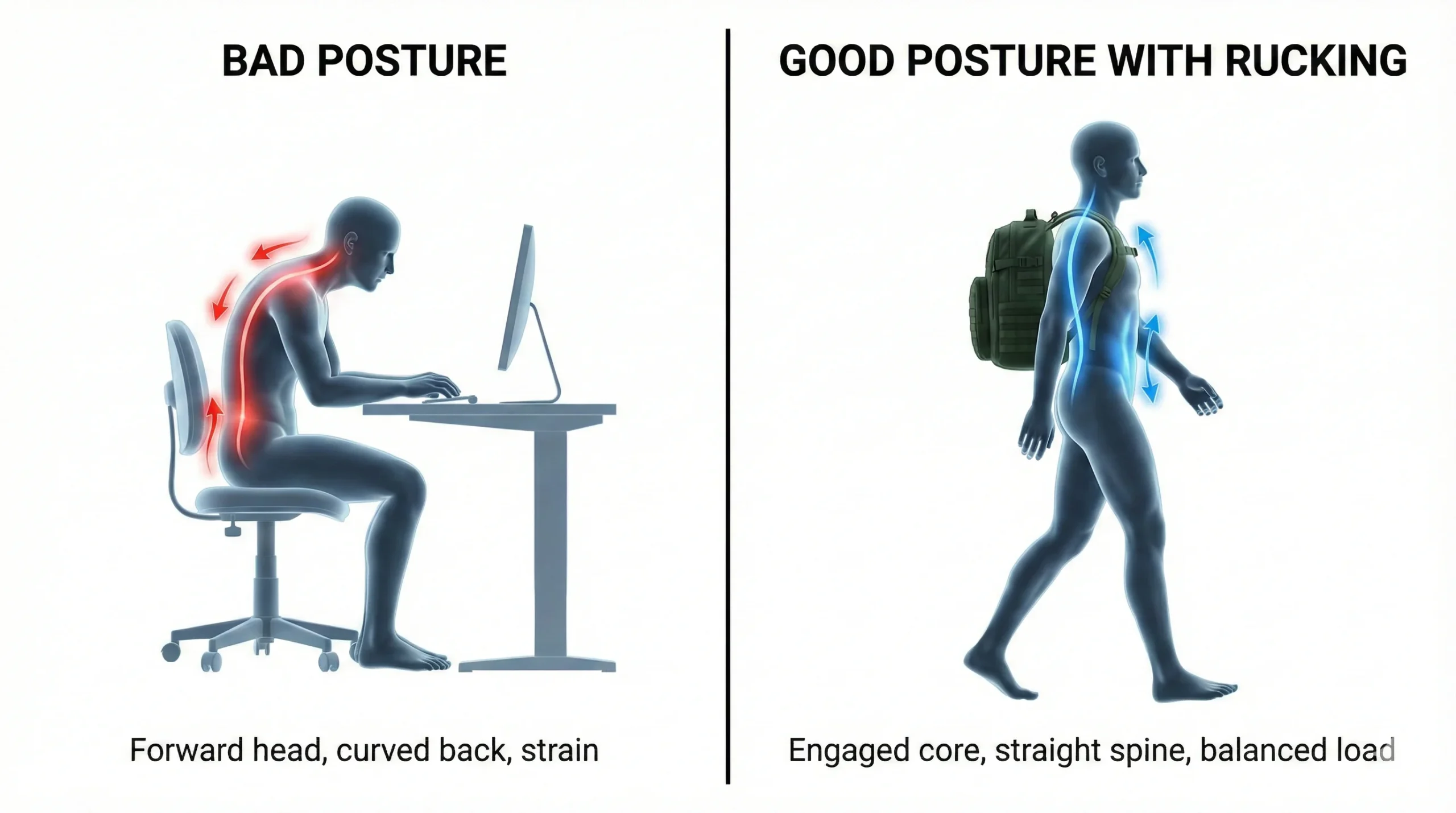
Most of us spend our days hunched over screens. A weighted rucksack physically forces your shoulders to retract and your spine to align to counterbalance the weight. It effectively fights the “office hump,” strengthening the posterior chain just by walking.
4. Caloric Burn Comparison
The math is simple: moving more mass requires more energy. Rucking burns up to 3x more calories than regular walking, depending on the weight carried and your speed.
| Feature | Walking (Unloaded) | Running | Rucking |
| Caloric Burn | Low (~250-300 cal/hr) | High (~600+ cal/hr) | Moderate-High (~450-600 cal/hr) |
| Joint Impact | Very Low | High (approx. 3x body weight) | Low (similar to walking) |
| Muscle Focus | Lower Body (Light) | Lower Body / Cardio | Full Body (Legs + Core + Back) |
| Bone Density | Minimal effect | Good | Excellent (High Load) |
| Injury Risk | Very Low | Moderate/High (Knees/Shins) | Low (if technique is correct) |
| Posture | Neutral | Can encourage hunching | Corrective (Retracts shoulders) |
Rucking Gear: From DIY to Pro Level
One of the biggest barriers to entry is the misconception that you need expensive gear. In my experience, that is false.
Beginner Level: The Towel Trick and Standard Backpacks
Don’t rush to buy a $300 tactical bag. The smartest way to start is the DIY method.
-
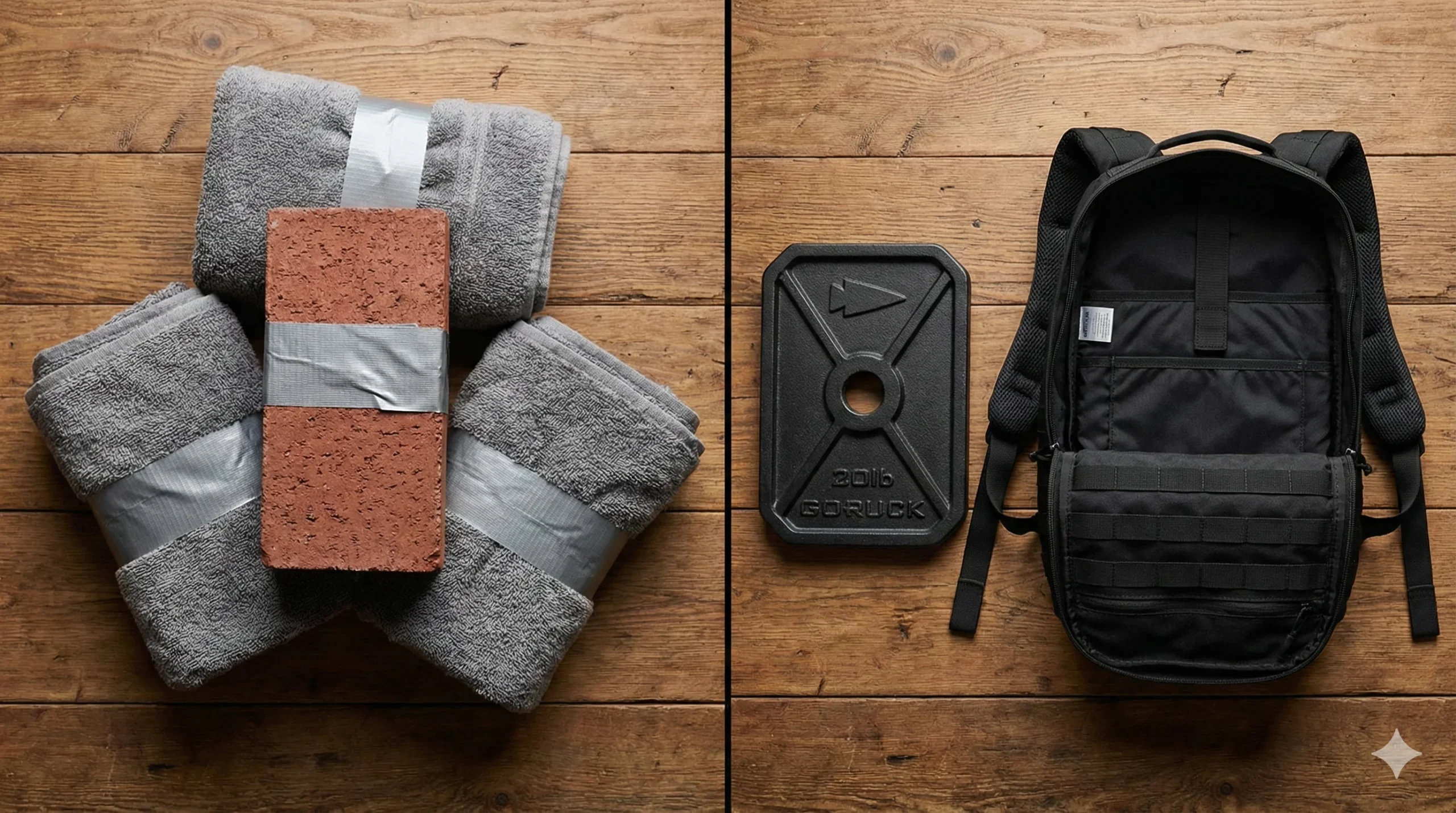
The Method: Take standard bricks or weight plates.
-
The Secret: Wrap them in thick towels. Do not skip this. If you don’t, the hard edges will dig into your spine.
-
The Pack: Place them in a sturdy school backpack (like a JanSport) or a cheap military surplus bag. Cinch the straps tight so the weight sits high on your back.
Pro Level: Rucking Plates and Center of Gravity
People eventually upgrade to pro gear (like Goruck) for one main reason: Center of Gravity.
Standard backpacks pull you backward. Dedicated rucking backpacks hold specially designed flat iron plates explicitly against your spine. This keeps the weight stable and reduces the leverage on your lower back, making the movement much more comfortable over long distances.
Footwear: Military Boots vs. Trail Runners?
You do not need heavy combat boots. In fact, they can be detrimental if you aren’t used to them.
My recommendation: Use Trail Running shoes with good support. They offer grip and stability without the weight of a boot. Avoid super-soft “cushioned” running shoes; the instability combined with extra weight is a recipe for a twisted ankle.
How to Start Without Injury: Technique & Common Mistakes
Rucking is low risk, but not zero risk. Here are the “in the trenches” mistakes I see constantly.
The 10-20% Rule: Managing Load and Ego
The most common error is The Ego Error. Just because you squat 100kg doesn’t mean you should ruck with 30kg.
-
The Rule: Start with 10% of your body weight. If you weigh 80kg, carry 8kg.
-
Build up gradually to 20%. Going beyond this (military standards are 30-35%) is unnecessary for general health and increases injury risk significantly.
Avoiding “Turtle Head” and Protecting Your Neck
When fatigue sets in, there is a natural tendency to crane your neck forward to compensate. I call this “The Turtle Head.” This destroys your cervical spine.
-
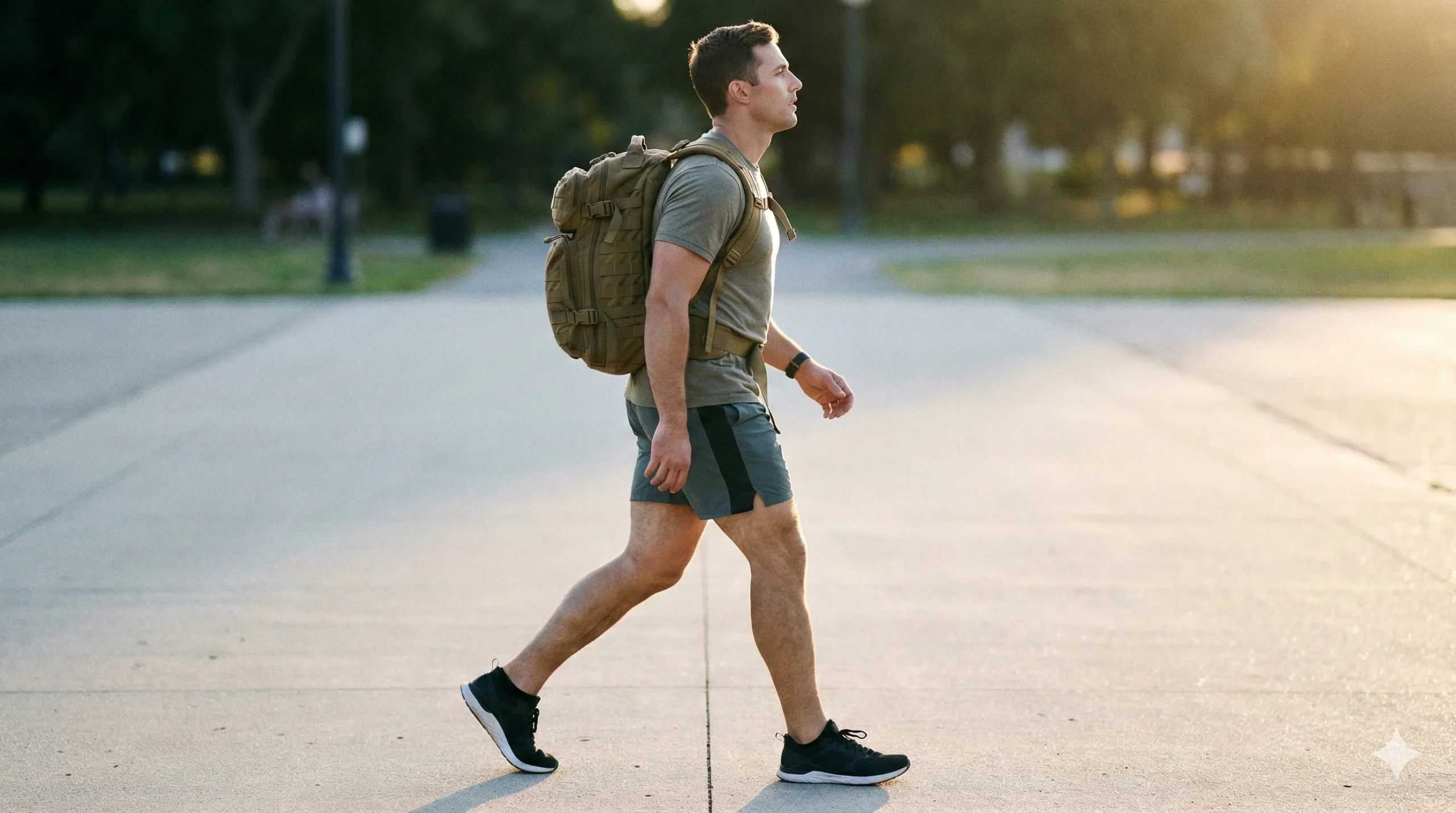
Mental Cue: Keep your ears aligned with your shoulders. Look at the horizon, not your feet.
The “Rucker’s Shuffle”: Why You Must Shorten Your Stride
You cannot walk with your normal relaxed stride. With weight, you must adopt the “Rucker’s Shuffle.”
- Shorten your stride.
- Increase your cadence (steps per minute).
- Land mid-foot, not hard on your heel.
This compact, utilitarian gait reduces the impact on your knees and hips.
Skin Care: Avoiding “The Silent Rub”
Many beginners forget that a heavy bag plus sweat equals sandpaper. If you wear a thin tank top, you will end up with friction burns on your lower back or shoulders.
-
The Fix: Wear a synthetic, high-collar shirt that covers your skin completely where the straps and bag sit.
Hybrid Routine: Turning a Walk into Strength Training
Want to make it a full workout? Try this simple hybrid routine I’ve used with great success:
- Walk for 5 minutes.
- Stop (keep the pack on).
- Perform 10 air squats or 10 pushups (hands elevated on a bench if needed).
- Repeat for 30-45 minutes.
This turns a simple walk into a total-body strength and endurance session.
🛍️ Mini Buying Guide: 3 Critical Features for Rucking Packs
If you decide to invest in specialized equipment, be sure to check these 3 points before buying:
- Wide, Padded Shoulder Straps: Thin straps will cut off circulation to your arms once you exceed 20lbs (9kg). Look for high-density foam straps.
- High Weight Pocket: The best rucking packs have an internal sleeve that holds the weight plate high up on your back (near your shoulder blades), not sagging at your lower back. This prevents lumbar strain.
- Durability (Cordura Fabric): Avoid standard nylon. Look for 500D or 1000D Cordura. A ruck plate has sharp metal edges; regular school bags will tear from the inside out within a month.
🎒 Rucking Gear Essentials
If you decide to invest in specialized equipment, be sure to check these 3 points before buying to avoid injury and wasted money.
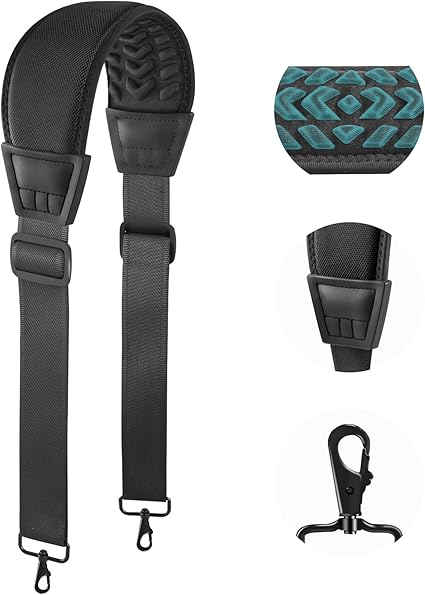
Wide, Padded Straps
Thin straps will cut off circulation to your arms once you exceed 20lbs (9kg). Look for high-density foam straps to handle the load.
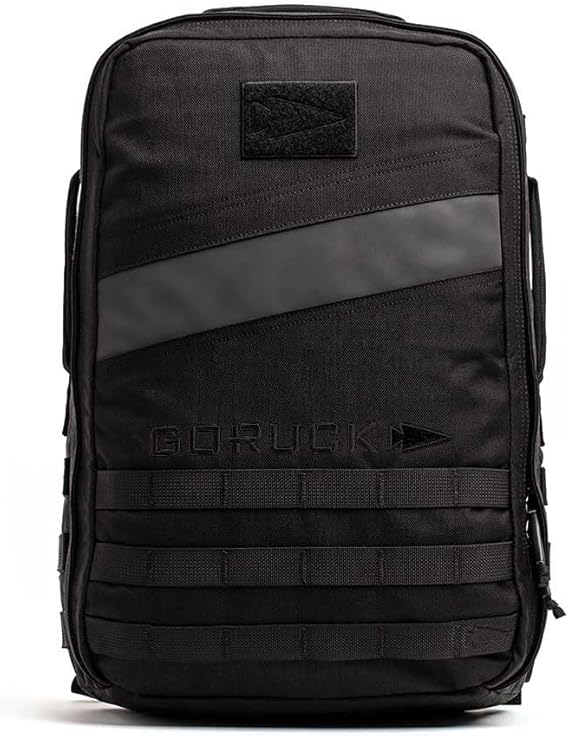
High Weight Pocket
The best packs have an internal sleeve that holds the weight plate high on your back (near shoulder blades), preventing lumbar strain.
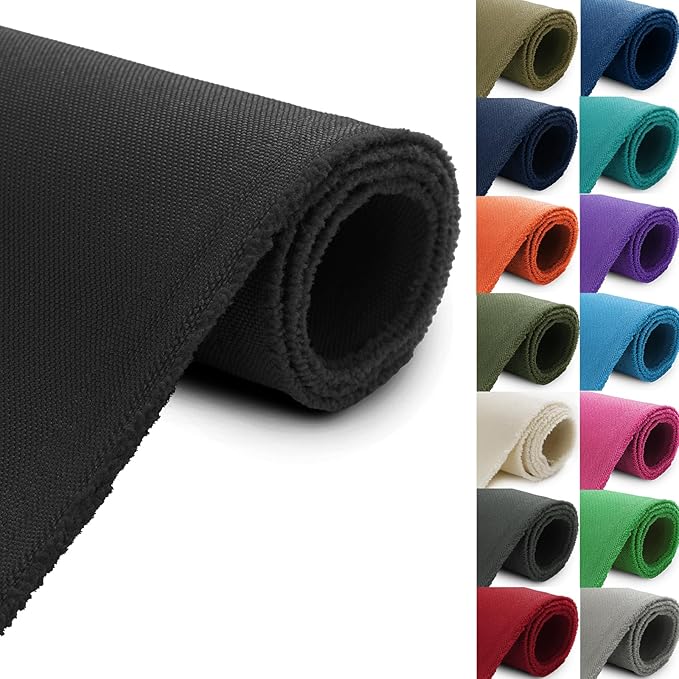
1000D Cordura Fabric
Avoid nylon. Ruck plates have sharp edges; regular school bags tear instantly. Look for 500D or 1000D Cordura for max durability.
*Prices and availability subject to change. As an Amazon Associate I earn from qualifying purchases.

❓ Frequently Asked Questions (FAQs)
Is rucking bad for your knees?
Generally, no. Because one foot is always on the ground, the impact is far lower than running. However, if you carry too much weight too soon or take overly long strides (heel striking), you can irritate the joints. Stick strictly to the 10-20% weight rule.
Can I ruck every day?
You can, but it’s best to treat it like resistance training. Start with 2-3 times a week to allow your traps, feet, and connective tissues to adapt to the new load. Recovery is when the muscle builds.
Does rucking build muscle?
Yes, primarily in the lower body (legs/glutes) and the posterior chain (upper back/traps). It won’t build explosive size like a heavy barbell squat, but it builds incredible “work capacity,” core strength, and muscular endurance.
How much weight should a beginner start with?
Ignore what you see on social media. Calculate 10% of your current body weight. If you are 200lbs, start with 20lbs. Master the technique and pace for 2 weeks before adding even 5 more pounds.
Final Verdict: Why You Should Start Rucking Today
Rucking is the antidote to the modern sedentary lifestyle. It requires minimal skill, minimal gear, and delivers maximum benefits for your heart, posture, and bones.
It pulls you out of the gym and into the outdoors, turning a simple walk into a powerhouse workout. Grab a backpack, wrap a brick in a towel, and step outside. The only thing you have to lose is the “office hump.”
Related posts: 🔥 You might also like…

Ashwagandha Benefits for Men: Testosterone, Stress, and What They Don’t Tell You
Ashwagandha Benefits for Men: Testosterone, Stress, and What They Don't Tell YouIf you search for...

Creatine Monohydrate: The Ultimate Guide to Benefits, Dosage, and Side Effects
Creatine Monohydrate: The Ultimate Guide to Benefits, Dosage, and Side EffectsCreatine Monohydrate...

Magnesium Glycinate vs. Citrate: Which is Best for Sleep? (The Ultimate Comparison)
Magnesium Glycinate vs. Citrate: Which is Best for Sleep? (The Ultimate Comparison)You are...